Continuing with the articles about object-oriented programming in python.
The previous article explained how to work with multiple inheritance. Now the diamond problem and how Python solves it will be explained.
Diamond inheritance is shown in the following figure:
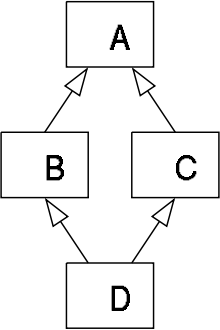
Where the parent class is class A, and classes B and C inherit from it; finally class D inherits from both B and C, and both of those classes, as we already know, inherit from A. Through which path is A inherited, through B or through C?
That is the diamond problem itself; you can find more information on the wikipedia page.
Each language has its own way of solving this problem. In the case of Python, it builds a list of classes, which are searched from left to right and from bottom to top (D,B,A,C,A), and then removes all occurrences of a repeated class except the last one. So the resolution order ends up being D,B,C,A.
An example in python is shown below:
#!/usr/bin/env python3


# -*- coding: utf-8 -*-


"""multiple herencia, problema del diamante"""


class A(object):


    def __init__(self,mensajeA):


        self.mensajeA = mensajeA


    @staticmethod


    def quienSoy():


        return "Soy A"


class B(A):


    def __init__(self,mensajeA, mensajeB):


        A.__init__(self,mensajeA)


        self.mensajeB = mensajeB


    @staticmethod


    def quienSoy():


        return "Soy B"


class C(A):


    def __init__(self,mensajeA,mensajeC):


        A.__init__(self,mensajeA)


        self.mensajeC = mensajeC


    @staticmethod


    def quienSoy():


        return "Soy C"


class D(B,C):


    def __init__(self,mensajeA,mensajeB,mensajeC,mensajeD):


        B.__init__(self,mensajeA,mensajeB)


        C.__init__(self,mensajeA,mensajeC)


        self.mensajeD = mensajeD


    @staticmethod


    def quienSoy():


        return "Soy D"


if __name__ == '__main__':


    ca = A("prueba de A")


    cb = B("prueba de A desde B","prueba de B")


    cc = C("prueba de A desde C","prueba de C")


    cd = D("prueba de A desde D","prueba de B desde D","prueba de C desde D","prueba de D")


    print ("Mensaje de A:",ca.mensajeA)


    print ("Quien es?: ",ca.quienSoy())


    print ("Mensaje 1 de B:", cb.mensajeB)


    print("Mensaje 2 de B:", cb.mensajeA)


    print ("Quien es?:",cb.quienSoy())


    print ("Mensaje 1 de C:", cc.mensajeC)


    print ("Mensaje 2 de C:", cc.mensajeA)


    print ("Quien es?:", cc.quienSoy())


    print ("Mensaje 1 de D:", cd.mensajeD)


    print ("Mensaje 2 de D:", cd.mensajeB)


    print ("Mensaje 3 de D:", cd.mensajeC)


    print ("Mensaje 4 de D:", cd.mensajeA)


    print("Quien es?:", cd.quienSoy())
Note that super was not used, because to resolve the evaluation it is easier to define the object directly instead of using super as a call into the inheritance chain.
When the code is run, the following output is produced:
Mensaje de A: prueba de A
Quien es?:  Soy A
Mensaje 1 de B: prueba de B
Mensaje 2 de B: prueba de A desde B
Quien es?: Soy B
Mensaje 1 de C: prueba de C
Mensaje 2 de C: prueba de A desde C
Quien es?: Soy C
Mensaje 1 de D: prueba de D
Mensaje 2 de D: prueba de B desde D
Mensaje 3 de D: prueba de C desde D
Mensaje 4 de D: prueba de A desde D
Quien es?: Soy D
As you can see, the execution of the last class shows the sequence explained in this article.
You can download the code of this example from gitlab.
Make a donation! If you liked the article you can make a donation with Bitcoin (BTC) using the digital wallet of your choice to the following address: 17MtNybhdkA9GV3UNS6BTwPcuhjXoPrSzV
Or by scanning the QR code from your wallet:
