In a previous article (Python tools for developing secure and quality code) I covered tools that make it easier to comply with Python's PEP8, improve code security and format it; in that case circle-ci was used for the evaluations.
In this article the evaluation will be done before pushing code to a git repository. The article is based on the following articles:
- Python Code Quality: Tools & Best Practices
- Python Code Quality
- pre-commit hooks you must know (broken link)
- Simplify your Python Code: Automating Code Complexity Analysis with Wily
- How to Improve your Python Code Style with Pre-commit Hooks (broken link)
- Keeping python code clean with pre-commit hooks: black, flake8 and isort (broken link)
The tools explained in the previous article will be covered again.
The code that will be evaluated is the following (it does not pass the checks):
import numpy as np
from scipy import signal as sp
import matplotlib.pylab as plt
import scipy.signal as signal
import scipy.stats as stats
import streamlit as st


def u(amplitud, t):
    """Función escalón unitario

    Args:
        amplitud (int): Amplitud del escalon
        t (list): Lista de tiempo

    Returns:
        list: Lista de valores
    """
    return amplitud*np.piecewise(t, [t < 0.0, t >= 0.0], [0, 1])


def OndaCuadrada(amplitud, t, fs=1):
    """Función  de Onda Cuadrada

    Args:
        amplitud (int): Amplitud de la segnal
        t (list): Lista de valores de tiempo
        fs (int, optional): Frecuencia.. Defaults to 1.

    Returns:
        list: Lista de valores
    """
    return ((sp.square(2 * fs*t)) * (amplitud / 2.0)) + (amplitud / 2.0)


def segnal_triangular(amplitud, simetria, t, fs=1):
    """Señal triangular

    Args:
        amplitud (int): Amplitud de la señal
        simetria (float): simetria de la señal
        t (list): Lista de valores que definen el tiempo.
        fs (int, optional): Frecuencia de la señal. Defaults to 1.

    Returns:
        list: Lista de valores de la señal
    """
    return amplitud*(signal.sawtooth(2 * np.pi * fs * t, simetria))


def seno(amplitud, t, fs=1):
    """ Onda Seno

    Args:
        amplitud (int): Amplitud de la señal
        t (list): Lista de valores de tiempo
        fs (int, optional): Frecuencia de la señal. Defaults to 1.

    Returns:
        list: Lista de valores de la señal de seno
    """
    return amplitud*np.sin(fs*t)


def coseno(amplitud, t, fs=1):
    """Señal de coseno

    Args:
        amplitud (int): Amplitud de la señal
        t (list): lista de valores para generar la señal
        fs (int, optional): Frecuencia de la señal. Defaults to 1.

    Returns:
        list: Lista de valores de la señal
    """
    return amplitud*np.cos(fs*t)


def tiempo(lim_inf, lim_sup, n):
    """Lista de valores que definen el tiempo de la señal

    Args:
        lim_inf (int): Límite inferior del tiempo
        lim_sup (int): Límite superior del tiempo
        n (int): Cantidad de valores a generar del tiempo

    Returns:
        list: Lista de valores del tiemmpo
    """
    return np.linspace(lim_inf, lim_sup, n)


def plot_signal(xi, xf, yi, yf, t, titulo, etiqueta, values):
    """Generación de la gráfica de la señal.

    Args:
        xi (int): x inicial
        xf (int): x final
        yi (int): y inicial
        yf (int): y final
        t (list): lista de valores de tiempo
        titulo (str): Título de la gráfica
        etiqueta (str): Etiqueta de la señal.
        values (list): Valores de la señal
    """
    plot(t, values, 'k', label=etiqueta, lw=2)
    xlim(xi, xf)


def main():
    # Definir título
    st.title("Generación de gráficas de señales")
    st.sidebar.header("Entradas:")
    segnales = ["Escalon Unitario", "Onda Cuadrada",
                "Onda triangular", "Seno", "Coseno"]

    resp = st.sidebar.selectbox("Tipo de señal", segnales)

    st.sidebar.header("Definición del tiempo:")
    st.sidebar.subheader("Rango")
    # SelectBox
    t0 = int(st.sidebar.selectbox(
        "", range(0, 10)
    ))
    ti = 0
    tf = t0
    n = 10000
    t = tiempo(ti, tf, n)
    st.sidebar.subheader("Amplitud de la señal")
    amplitud = int(st.sidebar.selectbox(
        "", range(1, 10)
    ))

    # numpy.ndarray
    if resp == "Escalon Unitario":
        ti = -tf
        resultado = u(amplitud, t)
    elif resp == "Onda Cuadrada":
        st.sidebar.subheader("Frecuencia de la señal")
        fs = int(st.sidebar.selectbox(
            "", range(1, 11)
        ))
        resultado = OndaCuadrada(amplitud, t, fs)
    elif resp == "Onda triangular":
        simetria = 0.5
        st.sidebar.subheader("Frecuencia de la señal")
        fs = int(st.sidebar.selectbox(
            "", range(1, 11)
        ))
        resultado = segnal_triangular(amplitud, simetria, t, fs)
    elif resp == "Seno":
        st.sidebar.subheader("Frecuencia de la señal")
        fs = int(st.sidebar.selectbox(
            "", range(1, 11)
        ))
        resultado = seno(amplitud, t, fs)
    elif resp == "Coseno":
        st.sidebar.subheader("Frecuencia de la señal")
        fs = int(st.sidebar.selectbox(
            "", range(1, 11)
        ))
        resultado = coseno(amplitud, t, fs)
    else:
        resultado = 0
        st.error("Error")

    fig = plt.figure()
    ax = fig.add_subplot(111)
    st.header(f"Gráfica de {resp}")
    ax.plot(t, resultado)
    ax.set_xlim(ti, tf)
    ax.set_xlabel("Tiempo")
    ax.set_ylabel("f(t)")
    ax.set_ylim(2*amplitud*-1, 2*amplitud)
    st.pyplot(fig)


if __name__ == "__main__":
    main()
Its requirements file is the following:
streamlit==0.70.0
scipy==1.5.4
numpy==1.19.3
matplotlib==3.3.3
Its initial file structure is the following (including hidden files):
signals_fft_streamlit
├── .git
│   ├── branches
│   ├── config
│   ├── description
│   ├── HEAD
│   ├── hooks
│   │   ├── applypatch-msg.sample
│   │   ├── commit-msg.sample
│   │   ├── fsmonitor-watchman.sample
│   │   ├── post-update.sample
│   │   ├── pre-applypatch.sample
│   │   ├── pre-commit.sample
│   │   ├── pre-merge-commit.sample
│   │   ├── prepare-commit-msg.sample
│   │   ├── pre-push.sample
│   │   ├── pre-rebase.sample
│   │   ├── pre-receive.sample
│   │   └── update.sample
│   ├── index
│   ├── info
│   │   └── exclude
│   ├── logs
│   │   ├── HEAD
│   │   └── refs
│   │       ├── heads
│   │       │   └── main
│   │       └── remotes
│   │           └── origin
│   │               └── HEAD
│   ├── objects
│   │   ├── info
│   │   └── pack
│   │       ├── pack-a6d9863d11286fbea66f5aafa93a9dbafaf3f4fc.idx
│   │       └── pack-a6d9863d11286fbea66f5aafa93a9dbafaf3f4fc.pack
│   ├── packed-refs
│   └── refs
│       ├── heads
│       │   └── main
│       ├── remotes
│       │   └── origin
│       │       └── HEAD
│       └── tags
├── .gitignore
├── LICENSE
├── README.md
├── requirements.txt
└── src
    └── app.py
In the hooks you can define what runs before a commit using pre-commit, which will be covered later.
Code validation
Linters
Linters are programming tools that check code in any programming language.
Flake8
A tool that checks that the code complies with Python's PEP-8.
It can be installed via pip:
pip install flake8Run flake8 on the app.py file:
python -m flake8 src/app.py
src/app.py:5:1: F401 'scipy.stats' imported but unused
src/app.py:22:6: N802 function name 'OndaCuadrada' should be lowercase
src/app.py:37:20: W291 trailing whitespace
src/app.py:83:50: W291 trailing whitespace
src/app.py:104:43: W291 trailing whitespace
src/app.py:106:5: F821 undefined name 'plot'
src/app.py:107:5: F821 undefined name 'xlim'
The command output shows the lines of code where there are errors, the type of error and a description of it.
pep8-naming
In addition to flake you can use pep8-naming to comply with PEP8's naming rules.
To install it, use pip:
pip install pep8-namingRun the same flake8 command; the error message is:
src/app.py:22:6: N802 function name 'OndaCuadrada' should be lowercaseWhich already appeared in the previous run.
pycodestyle
It is another PEP-8 validation tool. png
Install it:
pip install pycodestyleRun it:
pycodestyle src/app.pyIn this case, since the flake8 error messages were already fixed, it returns no messages.
pylint
Install it:
pip install pylint Run it:
pylint src/app.py Code formatter
It lets you reformat the code so that it complies with a set of standards.
isort
It reorders the imports as follows:
- Standard library
- Third-party libraries
- Local libraries
Install it:
pip install isort It is used as follows:
isort src/app.py
Fixing /home/ernesto/proyectos/signals_fft_streamlit/src/app.py
Before, the imports looked like this:
import numpy as np
from scipy import signal as sp
import matplotlib.pylab as plt
import scipy.signal as signal
import scipy.stats as stats
import streamlit as st
Now:
import matplotlib.pylab as plt
import numpy as np
import scipy.signal as signal
import streamlit as st
from scipy import signal as sp
To only check the import order without making the change you can run:
python -m isort src/app.py --check-onlyTo see the changes without applying them you can use:
python -m isort src/app.py --diffBlack
A code formatter used to reformat code based on the Black code style (broken link), which is very close to PEP-8.
To install it:
pip install black To check the code without modifying it:
python -m black src/app.py --check
would reformat src/app.py
Oh no! 💥 💔 💥
1 file would be reformatted.
To see the differences without modifying it (only part of the code is shown):
--- src/app.py	2020-11-15 01:20:29.525556 +0000
+++ src/app.py	2020-11-15 01:29:54.278851 +0000
@@ -13,11 +13,11 @@
         t (list): Lista de tiempo

     Returns:
         list: Lista de valores
     """
-    return amplitud*np.piecewise(t, [t < 0.0, t >= 0.0], [0, 1])
+    return amplitud * np.piecewise(t, [t < 0.0, t >= 0.0], [0, 1])
To make the modifications:
python -m black src/app.py
reformatted src/app.py
All done! ✨ 🍰 ✨
1 file reformatted.
The code changed to (only part of the code is shown):
def u(amplitud, t):
    """Función escalón unitario

    Args:
        amplitud (int): Amplitud del escalon
        t (list): Lista de tiempo

    Returns:
        list: Lista de valores
    """
    return amplitud * np.piecewise(t, [t < 0.0, t >= 0.0], [0, 1])
Other similar tools are YAPF and autopep8
Security vulnerability scanning
There are tools that evaluate the security vulnerabilities of the code and its dependencies.
Bandit
Bandit is a tool designed to find security issues in Python code.
Install it:
pip install bandit Run it as follows:
bandit -r src/app.py
[main]	INFO	profile include tests: None
[main]	INFO	profile exclude tests: None
[main]	INFO	cli include tests: None
[main]	INFO	cli exclude tests: None
[main]	INFO	running on Python 3.8.3
Run started:2020-11-15 01:44:06.048642

Test results:
	No issues identified.

Code scanned:
	Total lines of code: 119
	Total lines skipped (#nosec): 0

Run metrics:
	Total issues (by severity):
		Undefined: 0.0
		Low: 0.0
		Medium: 0.0
		High: 0.0
	Total issues (by confidence):
		Undefined: 0.0
		Low: 0.0
		Medium: 0.0
		High: 0.0
Files skipped (0):
As you can see, the code has no security problems.
Safety
Safety is a tool that checks the application's dependencies for security issues.
Install it:
pip install safetyRun it as follows:
safety check
+==============================================================================+
|                                                                              |
|                               /$$$$$$            /$$                         |
|                              /$$__  $$          | $$                         |
|           /$$$$$$$  /$$$$$$ | $$  \__//$$$$$$  /$$$$$$   /$$   /$$           |
|          /$$_____/ |____  $$| $$$$   /$$__  $$|_  $$_/  | $$  | $$           |
|         |  $$$$$$   /$$$$$$$| $$_/  | $$$$$$$$  | $$    | $$  | $$           |
|          \____  $$ /$$__  $$| $$    | $$_____/  | $$ /$$| $$  | $$           |
|          /$$$$$$$/|  $$$$$$$| $$    |  $$$$$$$  |  $$$$/|  $$$$$$$           |
|         |_______/  \_______/|__/     \_______/   \___/   \____  $$           |
|                                                          /$$  | $$           |
|                                                         |  $$$$$$/           |
|  by pyup.io                                              \______/            |
|                                                                              |
+==============================================================================+
| REPORT                                                                       |
| checked 136 packages, using default DB                                       |
+==============================================================================+
| No known security vulnerabilities found.                                     |
+==============================================================================+
To check only the list of packages in requirements.txt, run:
safety check -r requirements.txt
+==============================================================================+
|                                                                              |
|                               /$$$$$$            /$$                         |
|                              /$$__  $$          | $$                         |
|           /$$$$$$$  /$$$$$$ | $$  \__//$$$$$$  /$$$$$$   /$$   /$$           |
|          /$$_____/ |____  $$| $$$$   /$$__  $$|_  $$_/  | $$  | $$           |
|         |  $$$$$$   /$$$$$$$| $$_/  | $$$$$$$$  | $$    | $$  | $$           |
|          \____  $$ /$$__  $$| $$    | $$_____/  | $$ /$$| $$  | $$           |
|          /$$$$$$$/|  $$$$$$$| $$    |  $$$$$$$  |  $$$$/|  $$$$$$$           |
|         |_______/  \_______/|__/     \_______/   \___/   \____  $$           |
|                                                          /$$  | $$           |
|                                                         |  $$$$$$/           |
|  by pyup.io                                              \______/            |
|                                                                              |
+==============================================================================+
| REPORT                                                                       |
| checked 4 packages, using default DB                                         |
+==============================================================================+
| No known security vulnerabilities found.                                     |
+==============================================================================+
Static typing verification
Since Python 3.7, Python supports, as a form of documentation, the definition of the types of a function's output and its arguments, and there are now tools that verify static typing.
Mypy
Mypy is an optional static type checker for Python that aims to combine the benefits of dynamic (or "duck") typing and static typing.
Install it:
pip install mypy Use it:
mypy src/app.py
src/app.py:1: error: No library stub file for module 'matplotlib.pylab'
src/app.py:1: note: (Stub files are from https://github.com/python/typeshed)
src/app.py:1: error: No library stub file for module 'matplotlib'
src/app.py:2: error: No library stub file for module 'numpy'
src/app.py:3: error: No library stub file for module 'scipy.signal'
src/app.py:3: error: No library stub file for module 'scipy'
src/app.py:4: error: Cannot find module named 'streamlit'
src/app.py:4: note: See https://mypy.readthedocs.io/en/latest/running_mypy.html#missing-imports
To ignore these errors use # type: ignore, as shown below:
import matplotlib.pylab as plt  # type: ignore
import numpy as np  # type: ignore
import scipy.signal as signal  # type: ignore
import streamlit as st  # type: ignore
from scipy import signal  # type: ignore
Run it again and those initial errors no longer appear.
An example of static typing is shown below:
def u(amplitud: int, t: np.ndarray) -> np.ndarray:
    """Función escalón unitario

    Args:
        amplitud (int): Amplitud del escalon
        t (np.ndarray): Lista de tiempo

    Returns:
        np.ndarray: Lista de valores
    """
    return amplitud * np.piecewise(t, [t < 0.0, t >= 0.0], [0, 1])

def onda_cuadrada(amplitud: int, t: np.ndarray, fs: int = 1) ->np.ndarray:
    """Función  de Onda Cuadrada

    Args:
        amplitud (int): Amplitud de la segnal
        t (list): Lista de valores de tiempo
        fs (int, optional): Frecuencia.. Defaults to 1.

    Returns:
        list: Lista de valores
    """
    return ((sp.square(2 * fs * t)) * (amplitud / 2.0)) + (amplitud / 2.0)
Another way to ignore all errors is the following:
#!/usr/bin/env python
#-*- coding: utf-8 -*-
# mypy: ignore-errors
Documentation validation
pydocstyle
pydocstyle is a tool that validates the format of the documentation.
Install it:
pip install pydocstyleUse it:
pydocstyle src/app.py
src/app.py:1 at module level:
        D100: Missing docstring in public module
src/app.py:9 in public function `u`:
        D400: First line should end with a period (not 'o')
src/app.py:22 in public function `onda_cuadrada`:
        D400: First line should end with a period (not 'a')
src/app.py:36 in public function `segnal_triangular`:
        D205: 1 blank line required between summary line and description (found 0)
src/app.py:36 in public function `segnal_triangular`:
        D400: First line should end with a period (not 'r')
src/app.py:50 in public function `seno`:
        D400: First line should end with a period (not 'o')
src/app.py:64 in public function `coseno`:
        D400: First line should end with a period (not 'o')
src/app.py:78 in public function `tiempo`:
        D205: 1 blank line required between summary line and description (found 0)
src/app.py:78 in public function `tiempo`:
        D400: First line should end with a period (not 'l')
src/app.py:90 in public function `main`:
        D103: Missing docstring in public function
Cyclomatic Complexity, number of lines of code
There are tools to validate cyclomatic complexity, such as:
In this case wily will be tried
Wily
Wily is an application for tracking the complexity of Python code and applications.
Install it:
pip install wilyYou need to index the project by running:
wily build src/
Found 1 revisions from 'git' archiver in '/home/ernesto/proyectos/signals_fft_streamlit'.
Running operators - maintainability,raw,cyclomatic,halstead
Processing |################################| 4/4
Completed building wily history, run `wily report <file>` or `wily index` to see more.
To generate the report for app.py, run:
wily report src/app.py
Using default metrics ['maintainability.mi', 'raw.loc', 'cyclomatic.complexity', 'halstead.h1']
-----------History for ['maintainability.mi', 'raw.loc', 'cyclomatic.complexity', 'halstead.h1']------------
╒════════════╤════════════════╤════════════╤═════════════════════════╤═════════════════╤═════════════════════════╤═══════════════════╕
│ Revision   │ Author         │ Date       │ Maintainability Index   │ Lines of Code   │ Cyclomatic Complexity   │ Unique Operands   │
╞════════════╪════════════════╪════════════╪═════════════════════════╪═════════════════╪═════════════════════════╪═══════════════════╡
│ f2679c6    │ Ernesto Crespo │ 2020-11-14 │ 68.1377 (0)             │ 153 (0)         │ 12 (0)                  │ 7 (0)             │
╘════════════╧════════════════╧════════════╧═════════════════════════╧═════════════════╧═════════════════════════╧═══════════════════╛
In the report you can pass specific metrics:
wily report src/app.py loc sloc comments --message
-----------History for ('loc', 'sloc', 'comments')------------
╒════════════╤════════════════╤════════════════╤════════════╤═════════════════╤═══════════════════╤═══════════════════════╕
│ Revision   │ Message        │ Author         │ Date       │ Lines of Code   │ S Lines of Code   │ Multi-line comments   │
╞════════════╪════════════════╪════════════════╪════════════╪═════════════════╪═══════════════════╪═══════════════════════╡
│ f2679c6    │ Initial commit │ Ernesto Crespo │ 2020-11-14 │ 153 (0)         │ 71 (0)            │ 8 (0)                 │
╘════════════╧════════════════╧════════════════╧════════════╧═════════════════╧═══════════════════╧═══════════════════════╛
Cyclomatic Complexity
According to the publication by The Software Engineering Institute at Carnegie Mellon defines, which defines the complexity ranges:
- 1-10: Low risk, simple program.
- 11-20: Moderate risk, more complex program.
- 21-50: High risk, very difficult program.
-
50: Very high risk, unstable program.
Maintainability index
For this case:
- <65: Hardly maintainable.
- 65-85: Moderately maintainable.
-
85: Easy to maintain.
In the case of app.py it has a moderate risk and is moderately maintainable.
For more information on cyclomatic complexity, you can check Simplify your Python Code: Automating Code Complexity Analysis with Wily or the pdf from The Software Engineering Institute at Carnegie Mellon defines.
Putting it all together with pre-commit
pre-commit
Pre-commit is a framework for managing git hooks.
To install it:
pip install pre-commitTo initialize pre-commit, run:
$pre-commit install
pre-commit installed at .git/hooks/pre-commit
Yaml verification
To format yaml you can use the following configuration:
  - repo: https://github.com/pre-commit/pre-commit-hooks
    rev: v2.4.0
    hooks:
      - id: trailing-whitespace
      - id: end-of-file-fixer
      - id: check-added-large-files
      - id: check-yaml
        exclude: (template|ci).*\.(json|yml|yaml)$
isort
To validate with isort you have the following:
  - repo: https://github.com/asottile/seed-isort-config
    rev: v1.9.3
    hooks:
      - id: seed-isort-config
  - repo: https://github.com/pre-commit/mirrors-isort
    rev: v4.3.21
    hooks:
      - id: isort
For Wily
  - repo: local
    hooks:
      - id: wily
        name: wily
        entry: wily diff
        verbose: true
        language: python
        additional_dependencies: [wily]
Safety
  - repo: git://github.com/Lucas-C/pre-commit-hooks-safety
    rev: v1.1.3
    hooks:
      - id: python-safety-dependencies-check
Black
  - repo: https://github.com/ambv/black
    rev: stable
    hooks:
      - id: black
        language_version: python3.8
Pylint
  - repo: https://github.com/PyCQA/pylint
    rev: "pylint-2.6.0"
    hooks:
      - id: pylint
        args: ["--disable=similarities"]
Mypy
  - repo: https://github.com/pre-commit/mirrors-mypy
    rev: v0.790
    hooks:
      - id: mypy
        exclude: ^testing/resources/
Pyupgrade
  - repo: https://github.com/asottile/pyupgrade
    rev: v2.7.3
    hooks:
      - id: pyupgrade
        args: [--py36-plus]
Flake8
  - repo: https://gitlab.com/pycqa/flake8
    rev: 3.8.4
    hooks:
      - id: flake8
        additional_dependencies: [flake8-typing-imports==1.10.0]
Autopep8
  - repo: https://github.com/pre-commit/mirrors-autopep8
    rev: v1.5.4
    hooks:
      - id: autopep8
Blacken
  - repo: https://github.com/asottile/blacken-docs
    rev: v1.8.0
    hooks:
      - id: blacken-docs
        additional_dependencies: [black==20.8b1]
Bandit
  - repo: git://github.com/Lucas-C/pre-commit-hooks-bandit
    rev: v1.0.4
    hooks:
      - id: python-bandit-vulnerability-check
        exclude: /home/ernesto/proyectos/magnetic_fields/.virtualenvs/*
pydoctstyle
  - repo: local
    hooks:
      - id: pydocstyle
        name: pydocstyle
        entry: pydocstyle
        files: src/app.py
        verbose: true
        language: python
        additional_dependencies: [pydocstyle]
Complete file
The complete .pre-commit-config.yaml file contains the following:
# See https://pre-commit.com for more information
# See https://pre-commit.com/hooks.html for more hooks
repos:
  - repo: https://github.com/pre-commit/pre-commit-hooks
    rev: v2.4.0
    hooks:
      - id: trailing-whitespace
      - id: end-of-file-fixer
      - id: check-added-large-files
      - id: check-yaml
        exclude: (template|ci).*\.(json|yml|yaml)$
  - repo: https://github.com/asottile/seed-isort-config
    rev: v1.9.3
    hooks:
      - id: seed-isort-config
  - repo: https://github.com/pre-commit/mirrors-isort
    rev: v4.3.21
    hooks:
      - id: isort
  - repo: local
    hooks:
      - id: wily
        name: wily
        entry: wily diff
        verbose: true
        language: python
        additional_dependencies: [wily]
  - repo: local
    hooks:
      - id: pydocstyle
        name: pydocstyle
        entry: pydocstyle
        files: src/app.py
        verbose: true
        language: python
        additional_dependencies: [pydocstyle]
  - repo: git://github.com/Lucas-C/pre-commit-hooks-safety
    rev: v1.1.3
    hooks:
      - id: python-safety-dependencies-check
  - repo: https://github.com/ambv/black
    rev: stable
    hooks:
      - id: black
        language_version: python3.8
  - repo: https://github.com/PyCQA/pylint
    rev: "pylint-2.6.0"
    hooks:
      - id: pylint
        args: ["--disable=similarities"]
  - repo: https://github.com/pre-commit/mirrors-mypy
    rev: v0.790
    hooks:
      - id: mypy
        exclude: ^testing/resources/
  - repo: https://github.com/asottile/pyupgrade
    rev: v2.7.3
    hooks:
      - id: pyupgrade
        args: [--py36-plus]
  - repo: https://gitlab.com/pycqa/flake8
    rev: 3.8.4
    hooks:
      - id: flake8
        additional_dependencies: [flake8-typing-imports==1.10.0]
  - repo: https://github.com/pre-commit/mirrors-autopep8
    rev: v1.5.4
    hooks:
      - id: autopep8
  - repo: https://github.com/asottile/blacken-docs
    rev: v1.8.0
    hooks:
      - id: blacken-docs
        additional_dependencies: [black==20.8b1]
  - repo: git://github.com/Lucas-C/pre-commit-hooks-bandit
    rev: v1.0.4
    hooks:
      - id: python-bandit-vulnerability-check
        exclude: /home/ernesto/proyectos/magnetic_fields/.virtualenvs/*
You can run the following command for the verification:
pre-commit run --all-filesThis returns the messages as shown in the following image:
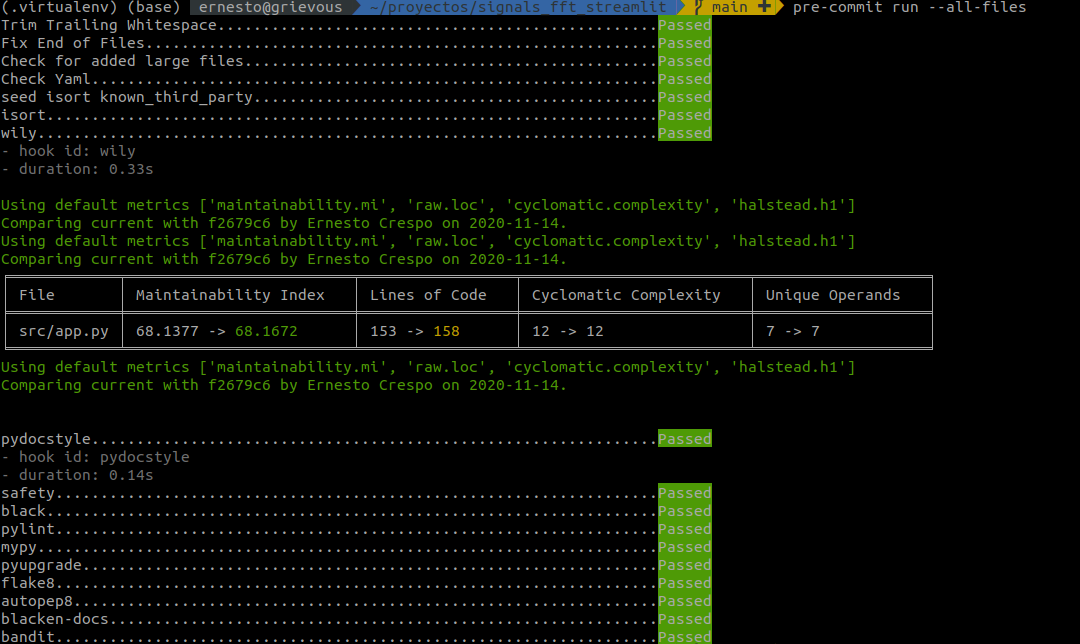
From now on, when you want to make a commit, pre-commit will evaluate the hooks and you have to fix the errors until there are none, and that is when the commit will be made.
Final file structure.
ignals_fft_streamlit
├── .bandit
├── .git
│   ├── branches
│   ├── COMMIT_EDITMSG
│   ├── config
│   ├── description
│   ├── HEAD
│   ├── hooks
│   │   ├── applypatch-msg.sample
│   │   ├── commit-msg.sample
│   │   ├── fsmonitor-watchman.sample
│   │   ├── post-update.sample
│   │   ├── pre-applypatch.sample
│   │   ├── pre-commit
│   │   ├── pre-commit.sample
│   │   ├── pre-merge-commit.sample
│   │   ├── prepare-commit-msg.sample
│   │   ├── pre-push.sample
│   │   ├── pre-rebase.sample
│   │   ├── pre-receive.sample
│   │   └── update.sample
│   ├── index
│   ├── info
│   │   └── exclude
│   ├── logs
│   │   ├── HEAD
│   │   └── refs
│   │       ├── heads
│   │       │   ├── feat
│   │       │   │   └── validado
│   │       │   └── main
│   │       └── remotes
│   │           └── origin
│   │               └── HEAD
│   ├── ORIG_HEAD
│   ├── packed-refs
│   └── refs
│       ├── heads
│       │   ├── feat
│       │   │   └── validado
│       │   └── main
│       ├── remotes
│       │   └── origin
│       │       └── HEAD
│       └── tags
├── .gitignore
├── .isort.cfg
├── LICENSE
├── .pre-commit-config.yaml
├── .pylintrc
├── README.md
├── requirements.txt
└── src
    └── app.py
The final app.py file ended up like this:
"""WebApp with streamlit graph signals."""
import matplotlib.pylab as plt  # type: ignore
import numpy as np  # type: ignore
import streamlit as st  # type: ignore
from scipy import signal  # type: ignore # pylint: disable=import-error


def u(amplitud: int, t: np.ndarray) -> np.ndarray:
    """Función escalón unitario.

    Args:
        amplitud(int): Amplitud del escalon
        t(np.ndarray): Lista de tiempo

    Returns:
        np.ndarray: Lista de valores
    """
    return amplitud * np.piecewise(t, [t < 0.0, t >= 0.0], [0, 1])


def onda_cuadrada(amplitud: int, t: np.ndarray, fs: int = 1) -> np.ndarray:
    """Función  de Onda Cuadrada.

    Args:
        amplitud(int): Amplitud de la segnal
        t(list): Lista de valores de tiempo
        fs(int, optional): Frecuencia.. Defaults to 1.

    Returns:
        list: Lista de valores
    """
    return ((signal.square(2 * fs * t)) * (amplitud / 2.0)) + (amplitud / 2.0)


def segnal_triangular(
    amplitud: int, simetria: float, t: np.ndarray, fs: int = 1
) -> np.ndarray:
    """Señal triangular.

    Args:
        amplitud(int): Amplitud de la señal
        simetria(float): simetria de la señal
        t(np.ndarray): Lista de valores que definen el tiempo.
        fs(int, optional): Frecuencia de la señal. Defaults to 1.

    Returns:
        np.ndarray: Lista de valores de la señal
    """
    return amplitud * (signal.sawtooth(2 * np.pi * fs * t, simetria))


def seno(amplitud: int, t: np.ndarray, fs: int = 1) -> np.ndarray:
    """Onda Seno.

    Args:
        amplitud(int): Amplitud de la señal
        t (np.ndarray): Lista de valores de tiempo
        fs (int, optional): Frecuencia de la señal. Defaults to 1.

    Returns:
        np.ndarray: Lista de valores de la señal de seno
    """
    return amplitud * np.sin(fs * t)


def coseno(amplitud: int, t: np.ndarray, fs: int = 1) -> np.ndarray:
    """Señal de coseno.

    Args:
        amplitud (int): Amplitud de la señal
        t (np.ndarray): lista de valores para generar la señal
        fs (int, optional): Frecuencia de la señal. Defaults to 1.

    Returns:
        np.ndarray: Lista de valores de la señal
    """
    return amplitud * np.cos(fs * t)


def tiempo(lim_inf: int, lim_sup: int, n: int) -> np.ndarray:
    """Lista de valores que definen el tiempo de la señal.

    Args:
        lim_inf (int): Límite inferior del tiempo
        lim_sup (int): Límite superior del tiempo
        n (int): Cantidad de valores a generar del tiempo

    Returns:
        np.ndarray: Lista de valores del tiemmpo
    """
    return np.linspace(lim_inf, lim_sup, n)


def main():
    """Ejecución Streamlit webApp."""
    st.title(  # pylint: disable=no-value-for-parameter
        "Generación de gráficas de señales"
    )  # pylint: disable=no-value-for-parameter
    st.sidebar.header("Entradas:")  # pylint: disable=no-value-for-parameter
    segnales = [
        "Escalon Unitario",
        "Onda Cuadrada",
        "Onda triangular",
        "Seno",
        "Coseno",
    ]

    resp = st.sidebar.selectbox("Tipo de señal", segnales)

    st.sidebar.header("Definición del tiempo:")
    st.sidebar.subheader("Rango")
    # SelectBox
    t0 = int(st.sidebar.selectbox("", range(0, 10)))
    ti = 0
    tf = t0
    n = 10000
    t = tiempo(ti, tf, n)
    st.sidebar.subheader("Amplitud de la señal")
    amplitud = int(st.sidebar.selectbox("", range(1, 10)))

    # numpy.ndarray
    if resp == "Escalon Unitario":
        ti = -tf
        resultado = u(amplitud, t)
    elif resp == "Onda Cuadrada":
        st.sidebar.subheader("Frecuencia de la señal")
        fs = int(st.sidebar.selectbox("", range(1, 11)))
        resultado = onda_cuadrada(amplitud, t, fs)
    elif resp == "Onda triangular":
        simetria = 0.5
        st.sidebar.subheader("Frecuencia de la señal")
        fs = int(st.sidebar.selectbox("", range(1, 11)))
        resultado = segnal_triangular(amplitud, simetria, t, fs)
    elif resp == "Seno":
        st.sidebar.subheader("Frecuencia de la señal")
        fs = int(st.sidebar.selectbox("", range(1, 11)))
        resultado = seno(amplitud, t, fs)
    elif resp == "Coseno":
        st.sidebar.subheader("Frecuencia de la señal")
        fs = int(st.sidebar.selectbox("", range(1, 11)))
        resultado = coseno(amplitud, t, fs)
    else:
        resultado = 0
        st.error("Error")

    fig = plt.figure()
    ax = fig.add_subplot(111)
    st.header(f"Gráfica de {resp}")
    ax.plot(t, resultado)
    ax.set_xlim(ti, tf)
    ax.set_xlabel("Tiempo")
    ax.set_ylabel("f(t)")
    ax.set_ylim(2 * amplitud * -1, 2 * amplitud)
    st.pyplot(fig)


if __name__ == "__main__":
    main()
The repository where you can see the files is on github
Make a donation! If you liked the article you can make a donation with Bitcoin (BTC) using the digital wallet of your choice at the following address: 17MtNybhdkA9GV3UNS6BTwPcuhjXoPrSzV
Or by scanning the QR code from your wallet:
