This article is based on the English article The Perceptron .
A perceptron is a classifier and one of the simplest kinds of Artificial Neural Network . The goal is to take the characteristics of a biological neural network and replicate it as an algorithm.
The following figure shows a neural network with two inputs; each input has its weight, then they are summed and the activation function generates an output.
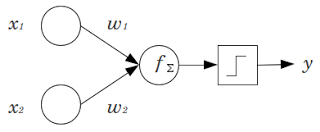
The mathematical equation would be something like:
y = FuncionActivacion(x1*w1+x2*w2)The activation function for a square wave is:
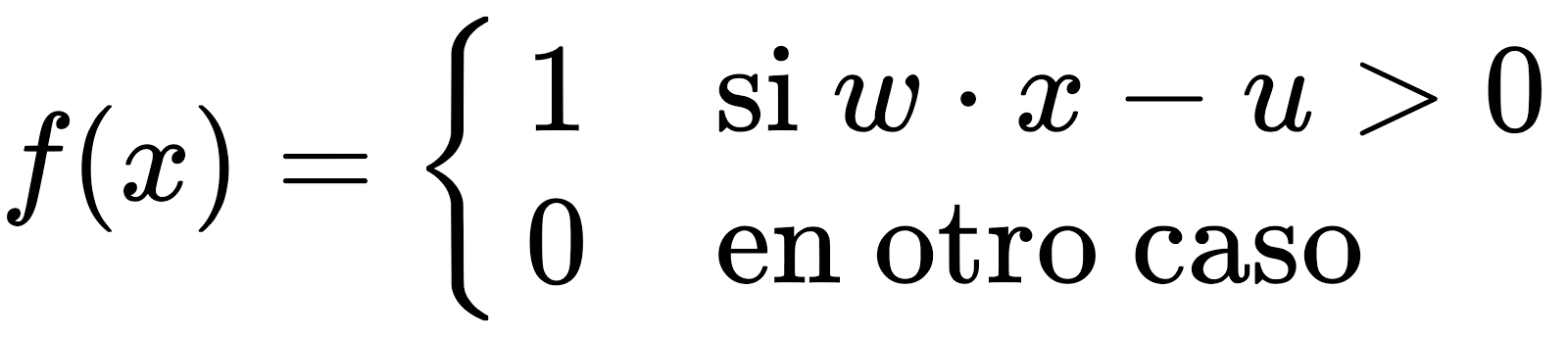
Where the activation function can be a square wave (there are more activation functions).
Here is another perceptron with 5 input signals.
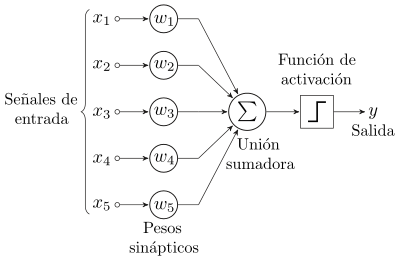
The code is shown below:
#!/usr/bin/env python3

# coding: utf-8


# # Importar librerías

from pylab import rand,plot,show,norm

# # Clase Perceptron

class Perceptron:

 def __init__(self):

  """ inicialización del perceptron  """

  self.w = rand(2)*2-1 # pesos

  self.tasaAprendizaje = 0.1


 def respuesta(self,x):

  """ saldia del perceptron """

  y = x[0]*self.w[0]+x[1]*self.w[1] # producto punto entre w y x

  if y >= 0:

   return 1

  else:

   return -1


 def actualizarPesos(self,x,iterError):

  """

  Actualizar estatus de los pesos, w en un tiempo t+1 es w(t+1)= w(t) + learningRate*(d-r)*x

  donde d es la salida deseada y r la respuesta del perceptro, iteError es la diferencia entre

  d y r (d-r).

  """

  self.w[0] += self.tasaAprendizaje*iterError*x[0]

  self.w[1] += self.tasaAprendizaje*iterError*x[1]


 def entrenamiento(self,data):

  """

  Entra todo el vector en los datos, cada vector en los datos debe tener 3 elementos,

  el tercer elemento (x[2]) debe ser etiquetado (salida deseada)

  """

  learned = False

  iteration = 0

  while not learned:

   globalError = 0.0

   for x in data: # por cada muestra

    r = self.respuesta(x)

    if x[2] != r: # si tenemos un respuesta equivocada

     iterError = x[2] - r # respuesta deseada-respuesta actual

     self.actualizarPesos(x,iterError)

     globalError += abs(iterError)

   iteration += 1

   if globalError == 0.0 or iteration >= 100: # detiene por el criterio

    print ('iterations {}'.format(iteration))

    learned = True # detiene el aprendizaje


def datosGenerados(n):

    """

    genera un conjunto de datos, de dos dimensiones,  linealmente separados con

    n muestras. El tercer elemento de la muestra es la etiqueta.

    """

    xb = (rand(n)*2-1)/2-0.5

    yb = (rand(n)*2-1)/2+0.5

    xr = (rand(n)*2-1)/2+0.5

    yr = (rand(n)*2-1)/2-0.5

    inputs = []

    for i in range(len(xb)):

        inputs.append([xb[i],yb[i],1])

        inputs.append([xr[i],yr[i],-1])

    return inputs


trainset = datosGenerados(30) # generación de datos para entrenar

perceptron = Perceptron()   # Instancia del perceptron

perceptron.entrenamiento(trainset)  # Entrenamiento con el conjunto de datos

testset = datosGenerados(20)  # conjunto de datos para el test.


# Prueba del perceptron

for x in testset:

 r = perceptron.respuesta(x)

 if r != x[2]: # Si la respuesta no es correcta

  print ('error')

 if r == 1:

  plot(x[0],x[1],'ob')

 else:

  plot(x[0],x[1],'or')


# Se gráfica una línea de separación, la cual es ortogonal a w.

n = norm(perceptron.w)

ww = perceptron.w/n

ww1 = [ww[1],-ww[0]]

ww2 = [-ww[1],ww[0]]

plot([ww1[0], ww2[0]],[ww1[1], ww2[1]],'--k')

show()


# ##
When you run the script you get the following plot:
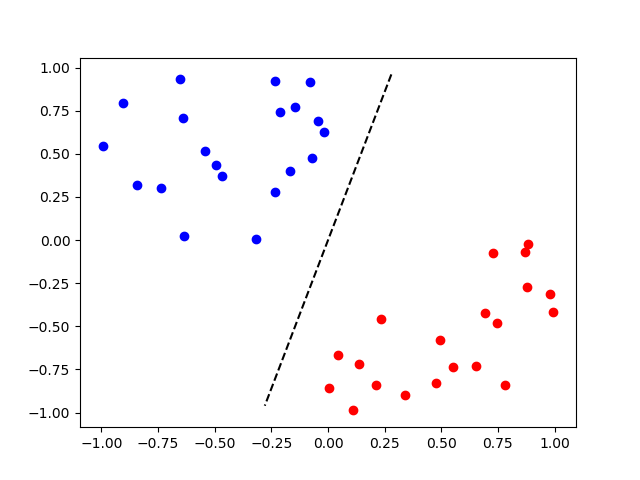
The blue dots belong to the first class and the red ones belong to the second. The dotted line is the separation line that the perceptron learned during training.
In upcoming articles we will keep working with the perceptron but using libraries such as scikit-learn and tensorflow.
You can download the python script and the jupyter notebook from github.
Make a donation! If you liked the article you can make a donation in Bitcoin (BTC) using the digital wallet of your choice to the following address: 17MtNybhdkA9GV3UNS6BTwPcuhjXoPrSzV
Or by scanning the QR code from your wallet: